VENDUE
/ SOLD
Owen YALANDJA
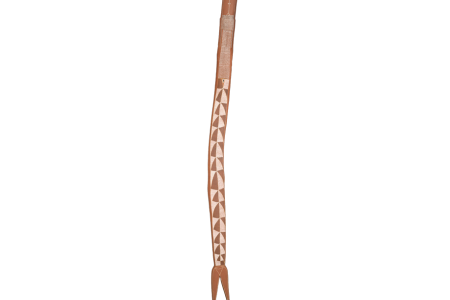
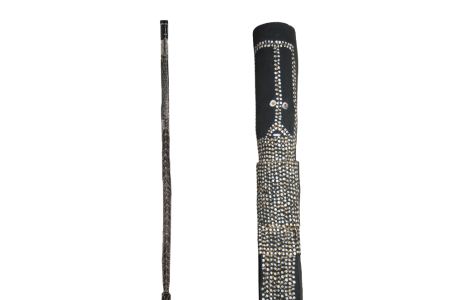
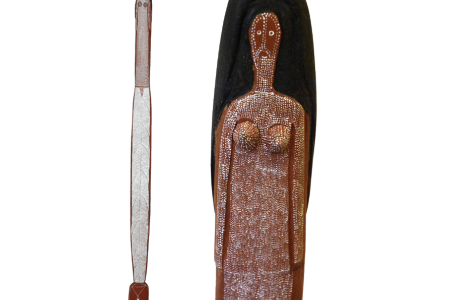
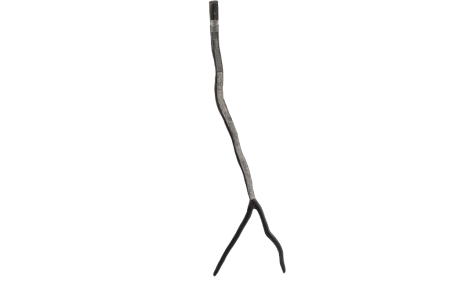
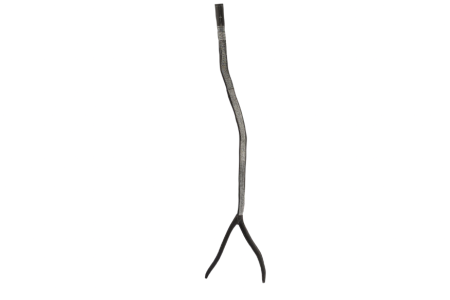
Yawkyawk
Yawkyawk
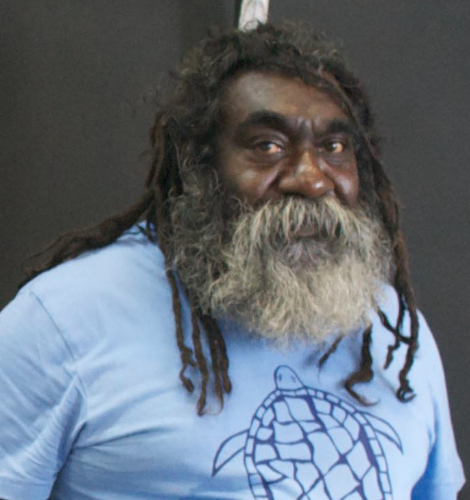
Owen Yalandja is a renowned Aboriginal artist from the Maningrida community in Arnhem Land, Northern Territory, Australia. A member of the Kuninjku people and the Dangkorlo clan, he is the custodian of a sacred site associated with the Yawkyawk, young female water spirits of the Dreaming. He carries forward the artistic legacy of his father, Crusoe Kuningbal, a pioneering sculptor and the creator of the first three-dimensional representations of the Mimi spirits.
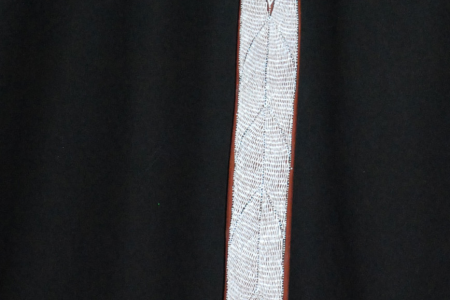
Yalandja is celebrated for his intricate sculptures and bark paintings depicting Mimi and Yawkyawk spirits. His figures are elongated and sinuous, often showing the Yawkyawk’s fish-like tail transforming into legs, reflecting the spirits’ dual nature and fluid movement. He carves primarily in Kurrajong wood, using natural curves to enhance the sense of motion, and decorates his works with detailed dot patterns and “X-ray” motifs inspired by his father, combined with his own innovations in arcs and V-shaped marks to suggest scales.
Since the 1990s, Yalandja has developed increasingly complex three-dimensional works, incorporating sculptural elements that emphasize the grace and fragility of these ancestral beings. His works are widely exhibited across Australia and internationally, held in major public and private collections, and have earned him recognition as one of the most influential contemporary Indigenous artists. In 2025, he was named a finalist in the Telstra National Aboriginal and Torres Strait Islander Art Awards (NATSIAA).
Owen Yalandja’s art exemplifies the continuation of multi-generational knowledge, blending innovation with deep cultural tradition, and remains central to the preservation and celebration of Kuninjku heritage.
Collections publiques:
•Musée des Confluences, Lyon
•Musée d’Art Aborigène, Utrecht, Pays-Bas
•Art Gallery of South Australia, Adélaïde
•Gantner Myer Collection, Etats-Unis
•National Gallery of Victoria, Melbourne,
•Queensland Art Gallery, Brisbane
•Art Gallery of the Northern Territory, Darwin
•British Museum, Londres
•Musée d’ethnographie de Genève (MEG), Geneva, Switzerland
•National Gallery of Australia, Canberra
•Australian Museum, Sydney
•Museum and Art Gallery of the Northern Territory, Darwin
•Art Gallery of South Australia, Adélaïde
•Artbank, Sydney
•Laverty Collection, Sydney
•Gantner Myer Collection, Etats-Unis
•David Betz private collection, New York, USA
•Walonia Aboriginal Art, The Netherlands
•Macquarie Bank Art Collection, Australia